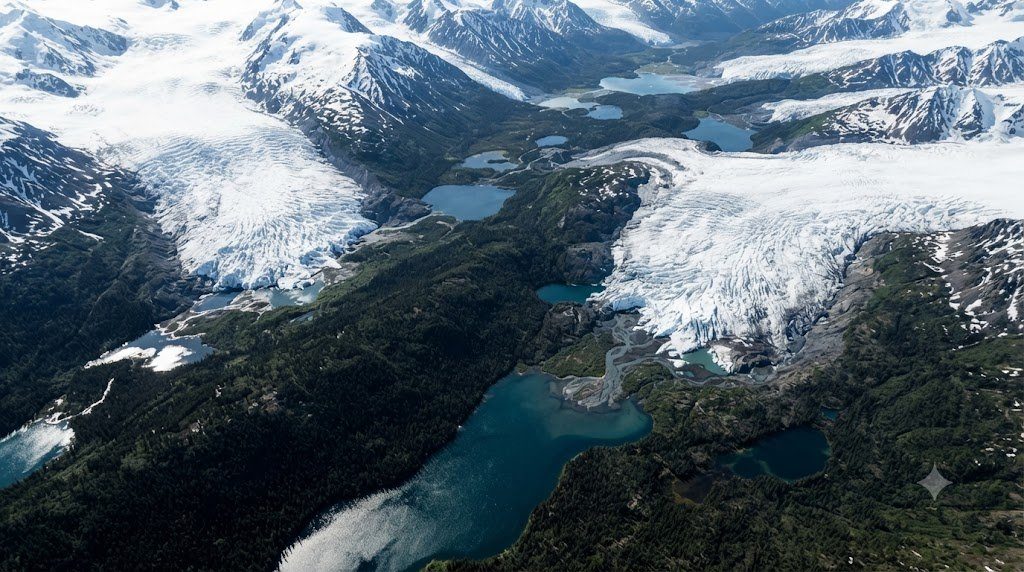
🧊 Planetary Albedo & Surface Radiative Equilibrium
A rigorous geophysical and thermodynamic dissertation on Earth’s surface radiative energy balance and planetary albedo feedbacks. We parameterize snow grain metamorphism and cryospheric albedo decay, analyze boreal forest canopy radiative masking, model desert and ocean surface directional reflectances, and calculate the contemporary Top-of-Atmosphere (TOA) energy imbalance driving planetary ocean heat uptake.
The fraction of incident solar radiation reflected by a planetary body into space without absorption is defined as its Bond Albedo ($\alpha_p$). For planet Earth, planetary albedo averages approximately 0.29 to 0.30, meaning that roughly 100 watts per square meter of incident solar flux is immediately returned to space. The remaining 70% (approximately 240 W/m2) is absorbed, driving the atmospheric circulation cells, ocean conveyor currents, and hydrological cycles.
Planetary albedo is not a static physical constant; it is a highly dynamic thermodynamic parameter modulated by cryospheric ice and snow cover, cloud fraction and optical depth, terrestrial biome distributions, and sea surface roughness. Because the absorption of solar radiation is governed directly by $1 – \alpha$, minute shifts in surface or planetary reflectance trigger powerful feedback loops that amplify initial climate perturbations.
In this comprehensive geophysical dissertation, we formalize the bidirectional reflectance distribution function (BRDF) of Earth surfaces, derive the snow grain metamorphosis models governing cryospheric albedo decay, analyze the radiative masking of boreal forest canopies, evaluate urban surface radiative modifications, and quantify the contemporary Earth Energy Imbalance (EEI) measured by satellite radiometry and Argo ocean floats.
1. Physics of Surface Reflectance and the BRDF Formalism
In rigorous optical physics, surface albedo is defined through the Bidirectional Reflectance Distribution Function (BRDF), $f_r(\theta_i, \phi_i; \theta_r, \phi_r; \lambda)$, which specifies the radiance reflected into a specific viewing direction per unit incident spectral irradiance:
f_r(\theta_i, \phi_i; \theta_r, \phi_r; \lambda) = \frac{d L_r(\theta_r, \phi_r; \lambda)}{d E_i(\theta_i, \phi_i; \lambda)} \quad [\text{sr}^{-1}]
where $\theta$ and $\phi$ denote zenith and azimuth angles, and $L_r$ and $E_i$ represent reflected radiance and incident irradiance. Integrating the BRDF across all viewing angles yields the directional-hemispherical reflectance (‘black-sky albedo’), and integrating across both incident and reflected hemispheres yields the bi-hemispherical reflectance (‘white-sky albedo’):
\alpha_{\text{white}}(\lambda) = \frac{1}{\pi} \int_0^{2\pi} \int_0^{\pi/2} \alpha_{\text{black}}(\theta_i; \lambda) \cos\theta_i \sin\theta_i \; d\theta_i d\phi_i
Natural Earth surfaces exhibit stark contrasts in shortwave albedo across visible (0.4 to 0.7 $\mu\text{m}$) and near-infrared (0.7 to 2.5 $\mu\text{m}$) spectral domains:
- Open Ocean Water ($\alpha \approx 0.06 – 0.08$): Except under high solar zenith angles where Fresnel specular reflection dominates, deep ocean water is an almost perfect blackbody absorber of visible and shortwave solar radiation.
- Fresh Dry Snow ($\alpha \approx 0.85 – 0.90$): Extremely high scattering in the visible spectrum due to multiple refractive scattering at ice-air crystal boundaries.
- Multi-Year Sea Ice ($\alpha \approx 0.55 – 0.70$): Weathered, brine-drained crystalline structure.
- Melt Ponds on Sea Ice ($\alpha \approx 0.15 – 0.35$): Standing pools of liquid freshwater on melting ice sheets that drastically lower surface reflectance.
- Boreal Evergreen Needleleaf Forests ($\alpha \approx 0.09 – 0.14$): Dense, dark conifers that absorb up to 90% of incoming sunlight.
- Tropical Broadleaf Evergreen Forests ($\alpha \approx 0.13 – 0.16$): High chlorophyll absorption in visible bands with intense cellular scattering in the near-infrared ‘red edge’ (0.7 to 1.1 $\mu\text{m}$).
- Quartz Desert Sand ($\alpha \approx 0.35 – 0.45$): High reflectance of mineral grains across visible and near-infrared spectra.
2. Snow Grain Metamorphism and Cryospheric Albedo Decay
The albedo of snow is not constant over time; it undergoes dramatic physical decay governed by snow grain metamorphism. Freshly fallen snow consists of delicate dendritic crystal geometries with high specific surface area and small effective optical grain radii ($r_e \approx 50 – 100 \; \mu\text{m}$). As incoming solar radiation penetrates the top few millimeters, light undergoes thousands of internal reflections at crystal boundaries, producing an integrated visible albedo of 0.90.
Over days and weeks, thermodynamic vapor pressure gradients drive snow grain growth. Water molecules sublime from high-curvature crystal tips and deposit in low-curvature grain necks, a process described by the Kelvin vapor pressure relation. Under warm conditions near the melting point (wet snow metamorphism), grains round and fuse into coarse grains ($r_e > 1000 \; \mu\text{m} = 1 \text{ mm}$).
The radiative consequences are quantified using radiative transfer modeling in ice media (e.g., the SNICAR model, Flanner et al., 2007). In ice, the imaginary part of the refractive index $\kappa(\lambda)$—which governs photon absorption—is nearly zero in the visible spectrum ($10^{-9}$ at 0.5 $\mu\text{m}$) but surges four orders of magnitude in the near-infrared ($10^{-3}$ at 1.5 $\mu\text{m}$). As snow grain radius $r_e$ increases:
- The mean photon path length within solid ice before encountering an air-crystal boundary increases proportionally with $r_e$.
- Photons have a drastically higher probability of being absorbed before escaping the snowpack.
- Near-infrared albedo plummets from 0.70 down to 0.20, reducing broadband snow albedo from 0.85 to below 0.60.
Light-Absorbing Particles (LAPs): Deposition of sub-ppm concentrations of black carbon, brown carbon, or mineral dust further collapses snow albedo. A black carbon concentration of merely 20 parts per billion (ppb) absorbs visible photons within the snowpack, depressing visible albedo by 3 to 5 percentage points. This triggers a runaway positive feedback: lower albedo accelerates solar absorption, warming the snowpack, speeding grain growth, exposing underlying dark ground, and driving rapid melt.
3. The Ice-Albedo Feedback and Nonlinear Climate Instability
The Ice-Albedo Feedback is the premier positive surface feedback in the climate system. Its mechanics are expressed mathematically through perturbation analysis of planetary energy balance:
\lambda_{\text{ice-albedo}} = – \frac{S_0}{4} \frac{\partial \alpha_p}{\partial T_s} = – \frac{S_0}{4} \left( \frac{\partial \alpha_p}{\partial A_{\text{ice}}} \frac{\partial A_{\text{ice}}}{\partial T_s} \right) > 0
Because higher global temperatures decrease cryospheric surface area ($\partial A_{\text{ice}} / \partial T_s < 0$) and decreasing ice cover lowers planetary albedo ($\partial \alpha_p / \partial A_{\text{ice}} > 0$), the product is negative. Multiplied by the negative sign in the radiative balance equation, $\lambda_{\text{ice-albedo}}$ is strictly positive ($+0.3$ to $+0.4 \text{ W m}^{-2} \text{ K}^{-1}$).
Bistability and the ‘Snowball Earth’ Catastrophe: In simple energy balance models (EBMs) first developed by Mikhail Budyko and William Sellers (1969), the ice-albedo feedback introduces extreme mathematical non-linearity:
C \frac{\partial T_s(\phi)}{\partial t} = \frac{S_0}{4} s(\phi) [1 – \alpha(T_s, \phi)] – (A + B T_s(\phi)) + D \nabla^2 T_s(\phi)
If global cooling expands sea ice equatorward beyond a critical threshold latitude (approximately 30 degrees latitude from the equator), the ice-albedo feedback enters an unstable runaway regime. The expanding high-albedo ice reflects so much solar radiation that planetary cooling outpaces meridional heat transport, plunging the entire planet into a global glaciation state known as ‘Snowball Earth’—a condition geological evidence confirms occurred during the Neoproterozoic Sturtian and Marinoan glaciations (~717 to 635 million years ago).
| Surface Type | Broadband Albedo (a) | Net Shortwave Absorbed (W/m2) | Thermal Emissivity (e) | Primary Albedo Modulator |
|---|---|---|---|---|
| Fresh Polar Snow | 0.85 – 0.90 | 34 – 51 W/m2 | 0.98 – 0.99 | Small grain size (re < 100 um), pristine purity |
| Aged / Melting Snow | 0.55 – 0.65 | 119 – 153 W/m2 | 0.97 – 0.98 | Grain coarsening (re > 500 um), dust deposition |
| Bare Multi-Year Sea Ice | 0.55 – 0.70 | 102 – 153 W/m2 | 0.97 | Brine drainage, surface sublimation crust |
| Arctic Melt Ponds | 0.15 – 0.35 | 221 – 289 W/m2 | 0.98 | Pond depth, underlying ice thickness |
| Open Polar Ocean | 0.06 – 0.08 | 313 – 320 W/m2 | 0.96 | Solar zenith angle, surface wind-wave roughness |
| Boreal Taiga Forest (Snow) | 0.18 – 0.25 | 255 – 279 W/m2 | 0.97 | Canopy masking, dark conifer needle absorption |
| Boreal Taiga (Snow-Free) | 0.09 – 0.12 | 299 – 309 W/m2 | 0.96 | Dense photosynthetic foliage, multiple scattering |
| Sahara Sand Erg | 0.38 – 0.45 | 187 – 211 W/m2 | 0.92 – 0.94 | Quartz grain mineralogy, lack of organic matter |
4. Vegetation-Albedo Masking: The Boreal Taiga Paradox
Terrestrial biomes exert profound controls on surface albedo through a phenomenon known as canopy masking. Nowhere is this effect more radiatively potent than across the high-latitude boreal forest biomes of Siberia, Canada, and Scandinavia.
When snow falls over open Arctic tundra or agricultural grasslands, it forms a continuous, uninterrupted white blanket with an albedo of 0.75 to 0.85, reflecting the vast majority of spring insolation back to space. However, when identical snowfall occurs over a boreal conifer forest (dominated by spruces, firs, and pines), the dark, vertically oriented evergreen canopies intercept the snow and shed it rapidly from needles. Crucially, the dark tree crowns protrude above the snowpack, creating a complex three-dimensional optical trap where solar photons undergo multiple reflections between dark branches and the snow surface.
Consequently, the winter and spring albedo of snow-covered boreal forests rarely exceeds 0.18 to 0.25—absorbing over three times more solar energy than adjacent snow-covered tundra. This produces the ‘Boreal Forest Radiative Paradox’: while afforestation in the tropics cools the planet through intense evapotranspiration, afforestation across high-latitude snowy regions can actually exert a net warming influence because the dark conifer canopy masking effect outweighs the carbon sequestration benefit.
5. Urban Radiative Budgets and the Urban Heat Island (UHI) Effect
Anthropic modification of land surfaces reaches its extreme expression in urban metropolitan landscapes, generating the Urban Heat Island (UHI) Effect. In metropolitan environments, natural vegetative and soil covers are systematically replaced with impervious engineered materials (asphalt, concrete, masonry, glass, and steel), fundamentally transforming surface energy partitioning:
R_n = H + LE + G + \Delta S + Q_F
where $R_n$ is net surface radiation, $H$ is sensible heat flux, $LE$ is latent heat flux (evapotranspiration), $G$ is ground heat conduction, and $Q_F$ is anthropogenic waste heat from combustion, vehicles, and building HVAC systems.
The urban surface radiative perturbation is governed by four coupled physical mechanisms:
- Depressed Surface Albedo: Dark asphalt pavements ($\alpha \approx 0.05 – 0.12$) absorb up to 95% of incident solar shortwave radiation, storing massive sensible heat compared to rural pastures ($\alpha \approx 0.20 – 0.25$).
- Urban Canyon Multiple Reflections: Deep vertical street canyons (building height to street width ratio $H/W > 2.0$) trap solar photons via multiple internal reflections, reducing effective bulk urban albedo and restricting the sky view factor (SVF), which impedes nocturnal radiative cooling to the cold sky.
- Collapse of Latent Heat Flux ($LE \rightarrow 0$): Impervious surfaces drain precipitation rapidly into stormwater sewers. Without soil moisture or vegetative transpiration, the Bowen ratio ($\beta = H / LE$) surges from rural values of $\beta \approx 0.2 – 0.5$ to extreme urban values of $\beta > 5.0$. Nearly all absorbed net radiation is partitioned into sensible heat $H$, driving nocturnal urban temperature anomalies of +3°C to +10°C above rural surroundings.
- Elevated Thermal Admittance: Concrete and granite possess high thermal conductivity and volumetric heat capacities, absorbing enormous thermal energy during daylight and releasing it slowly throughout the night.
6. Top-of-Atmosphere Radiative Imbalance and Ocean Heat Uptake
The ultimate integration of all planetary radiative processes—greenhouse gas trapping, aerosol scattering, and surface albedo feedbacks—is expressed in the Earth Energy Imbalance (EEI) at the Top of the Atmosphere:
\text{EEI} = F_{\text{absorbed solar}} – F_{\text{OLR}} = \frac{S_0}{4}(1 – \alpha_p) – F_{\text{OLR}} > 0
Satellite radiometers aboard NASA’s Clouds and the Earth’s Radiant Energy System (CERES) mission and the international Argo robotic float network provide direct empirical confirmation that Earth’s energy balance is currently out of equilibrium. Contemporary measurements reveal a sustained global net energy uptake of:
\text{EEI} \approx +0.76 \text{ to } +1.0 \text{ W/m}^2
Where does this excess energy go? Thermodynamic accounting reveals that:
- The Global Ocean absorbs ~91% of the trapped excess heat, quantified by temperature changes across the upper 2000 meters of the water column measured by ~4,000 Argo profiling floats.
- The Cryosphere absorbs ~5%, driving the melting of Greenland and Antarctic ice sheets, mountain glaciers, and Arctic sea ice.
- The Terrestrial Land Surface absorbs ~3%, warming continental soils and permafrost layers.
- The Atmosphere absorbs ~1%, driving observed atmospheric warming.
Because the oceans possess enormous heat capacity (specific heat of liquid water $c_p \approx 3990 \text{ J kg}^{-1} \text{ K}^{-1}$ compared to air $c_p \approx 1005 \text{ J kg}^{-1} \text{ K}^{-1}$), ocean thermal inertia delays equilibrium warming by decades. This planetary energy imbalance of ~0.8 W/m2 represents ‘warming in the pipeline’—irreversible heat commitment that guarantees continued global climatic warming until the planet radiates enough longwave energy to restore TOA balance.
7. Cloud Radiative Forcing and Net Albedo Modulation
While surface albedo exerts direct control over regional microclimates, the atmospheric component of planetary albedo is dominated by the global cloud field. Clouds cover approximately 67% of Earth’s surface at any given moment, functioning as dynamic solar reflectors and infrared blankets.
To quantify the net climatic influence of clouds, atmospheric physicists calculate the Cloud Radiative Effect (CRE) by comparing all-sky flux ($F$) with clear-sky flux ($F_{\text{clear}}$):
- Shortwave Cloud Radiative Effect (SWCRE):
\text{SWCRE} = F_{\text{solar}}^{\downarrow} (\alpha_{\text{clear}} – \alpha_{\text{all-sky}}) \approx -47 \text{ to } -50 \text{ W/m}^2
Clouds reflect approximately 50 W/m2 of solar shortwave radiation back to space, producing a massive global cooling effect.
- Longwave Cloud Radiative Effect (LWCRE):
\text{LWCRE} = F_{\text{OLR, clear}} – F_{\text{OLR, all-sky}} \approx +28 \text{ to } +30 \text{ W/m}^2
Cloud tops are colder than the Earth surface, absorbing surface infrared radiation and re-emitting at colder temperatures, trapping approximately 30 W/m2 of heat.
- Net Cloud Radiative Effect (Net CRE):
\text{Net CRE} = \text{SWCRE} + \text{LWCRE} \approx -48 + 30 = -18 \text{ to } -20 \text{ W/m}^2
In today’s climate, the shortwave cooling effect of clouds dominates over their longwave warming effect, resulting in a net planetary cooling of roughly 20 W/m2.
Cloud Altitude and Microphysical Regimes: The sign of cloud forcing depends critically on cloud altitude and optical depth. Low marine stratocumulus decks (cloud top < 2 km) possess warm cloud tops emitting longwave radiation nearly as efficiently as the ocean surface ($LWCRE \approx 0$), but exhibit high optical thickness ($\tau > 15$) reflecting up to 70% of incident sunlight (SWCRE strongly negative). Conversely, high thin cirrus clouds (altitude > 10 km, temperatures < -50°C) are optically thin to sunlight (SWCRE weak) but opaque to infrared radiation, exerting a potent net positive warming forcing. Shifts in the spatial distribution of these cloud regimes represent the central feedback governing planetary climate sensitivity.