🌐 Quantitative Climatological Taxonomy & Köppen-Geiger System
An exhaustive climatological taxonomy treatise on the modern Köppen-Geiger climate classification system. We derive the empirical mathematical thresholds defining the five primary thermal categories (A, B, C, D, E), examine precipitation seasonality modifiers (f, s, w, m), thermal severity sub-classes (a, b, c, d, h, k), bioclimatic vegetation boundaries, and contemporary climate change shifts across global biomes.
From the lush, multi-strata canopies of equatorial rainforests to the sun-baked sand dunes of the subtropical Sahara, and from the golden grasslands of temperate steppes to the barren, wind-scoured permafrost plains of the Arctic tundra, planet Earth exhibits an extraordinary kaleidoscope of regional climates. Yet, to transform raw meteorological observations into an organized, predictive science, climatologists require an objective, universal taxonomic framework to categorize the planetary surface into discrete climatic zones.
The undisputed cornerstone of global climatic taxonomy is the Köppen-Geiger Climate Classification System. Originally developed in 1884 by Russian-German climatologist and botanist Wladimir Köppen—and subsequently refined in collaboration with Rudolf Geiger—this empirical system established a revolutionary scientific premise: that natural native vegetation boundaries serve as the ultimate, living biological integrators of long-term regional climate!
Rather than relying on arbitrary geographical borders, Köppen constructed precise mathematical equations linking monthly mean surface temperatures, total annual precipitation, and seasonal precipitation distribution directly to the physiological survival thresholds of major botanical biomes. In this comprehensive climatological monograph, we derive the mathematical taxonomy governing all 30 official Köppen-Geiger climate classes, explore their underlying physical drivers, and evaluate how global warming is physically redrawing Earth’s climatic boundaries.
1. The Foundational Architecture of the Köppen-Geiger Taxonomic System
The Köppen-Geiger classification operates as a hierarchical, three-tiered alphanumeric coding system. The initial capital letter divides the Earth’s climates into five primary global categories based on fundamental thermal and hydrological thresholds:
- Group A (Tropical / Megathermal Climates): Defined by permanent high temperatures. Every single month of the year has a mean monthly temperature of $T_{\text{month}} \ge 18^\circ\text{C}$ ($64.4^\circ\text{F}$). There is no true winter season. Precipitation is abundant.
- Group B (Dry / Arid & Semi-Arid Climates): The only primary group defined by a hydrological moisture deficit rather than temperature. Potential Evapotranspiration (PET) exceeds total annual precipitation ($P_{\text{ann}} < P_{\text{threshold}}$). Subdivided into true hyper-arid deserts (BW) and semi-arid steppes (BS).
- Group C (Temperate / Mesothermal Climates): Mid-latitude climates featuring distinct summer and winter seasons. The coldest month has an average temperature between $-3^\circ\text{C}$ and $+18^\circ\text{C}$ (or $0^\circ\text{C}$ in some modern revisions), and at least one month has a mean temperature exceeding $+10^\circ\text{C}$ ($50^\circ\text{F}$).
- Group D (Continental / Microthermal Climates): Severe mid- to high-latitude climates found almost exclusively in the Northern Hemisphere. The coldest month averages $\le -3^\circ\text{C}$ (or $\le 0^\circ\text{C}$), while at least one month averages above $+10^\circ\text{C}$. Characterized by freezing snow cover and warm to hot summers.
- Group E (Polar & Alpine / Hekistothermal Climates): Permanent cryogenic regimes where the warmest month of the entire year has a mean temperature of $T_{\text{warmest}} < 10^\circ\text{C}$ ($50^\circ\text{F}$). Trees cannot physically grow in Group E climates due to inadequate growing degree days.
2. Mathematical Derivation of the Group B Aridity Threshold (P_threshold)
The mathematical genius of Köppen’s system is most vividly expressed in his derivation of the Aridity Precipitation Threshold ($P_{\text{threshold}}$ in millimeters). Köppen recognized that aridity is not simply a matter of total rainfall: 300 mm of rain falling in a cool subpolar climate supports lush boreal spruce forests, whereas that exact same 300 mm falling in a blistering subtropical desert evaporates instantly, supporting only barren scrub!
Furthermore, rain falling during hot summer months evaporates far more rapidly than rain falling during cool winter months. To account for this thermodynamic reality, Köppen formulated three conditional equations linking annual mean temperature ($T_{\text{ann}}$ in °C) to the seasonal concentration of precipitation:
- Case 1: Winter-Dominant Precipitation: If at least 70% of total annual precipitation falls in the winter six months:
P_{\text{threshold}} = 20 \times T_{\text{ann}}
- Case 2: Evenly Distributed Precipitation: If neither summer nor winter receives 70% of total precipitation:
P_{\text{threshold}} = 20 \times T_{\text{ann}} + 280
- Case 3: Summer-Dominant Precipitation: If at least 70% of total annual precipitation falls in the summer six months:
P_{\text{threshold}} = 20 \times T_{\text{ann}} + 140
Once $P_{\text{threshold}}$ is computed from these equations, the climate is categorized:
- If $P_{\text{ann}} < 0.5 \times P_{\text{threshold}}$ → BW (True Desert / Wüste)
- If $0.5 \times P_{\text{threshold}} \le P_{\text{ann}} < P_{\text{threshold}}$ → BS (Steppe / Semi-Arid Grassland)
- If $P_{\text{ann}} \ge P_{\text{threshold}}$ → The climate is non-arid, qualifying for Group A, C, or D!
3. Group A: Tropical Megathermal Taxonomy (Af, Am, Aw/As)
Tropical Group A climates are subdivided into three distinct classes based entirely on the depth of their driest month’s precipitation ($P_{\text{dry}}$):
- Af (Tropical Rainforest / Equatorial Climate): Permanent year-round humidity. Every single month of the year records at least $P_{\text{dry}} \ge 60\text{ mm}$ (2.4 inches) of rainfall. Governed continuously by the ascending convective branch of the Hadley cell and the ITCZ. Diurnal temperature fluctuations exceed the annual range of monthly mean temperatures (“Night is the winter of the tropics”). Supports multi-layered equatorial rainforest biomes with astonishing biodiversity (Amazon Basin, Congo Basin, Indonesian Archipelago).
- Am (Tropical Monsoon Climate): Experiences a brief, severe dry season ($P_{\text{dry}} < 60\text{ mm}$), but this dry deficit is compensated for by an extraordinarily ferocious wet summer monsoon downpour. The mathematical criterion is:
P_{\text{dry}} \ge 100 – \frac{P_{\text{ann}}}{25}
Encountered across coastal South Asia, Indochina, and the Caribbean rim. Supports dense monsoon deciduous forests that shed foliage during the brief dry spell.
- Aw / As (Tropical Wet-and-Dry / Savanna Climate): Features an extended, severe dry season where $P_{\text{dry}} < 60\text{ mm}$ and $P_{\text{dry}} < 100 - (P_{\text{ann}} / 25)$. Aw indicates winter-dry (the overwhelming majority), while As indicates rare summer-dry regimes. Controlled by seasonal alternation between the wet ITCZ in high sun and the arid subtropical high in low sun. Characterized by expansive, fire-adapted grasslands dotted with drought-resistant acacia trees (African Serengeti, Brazilian Cerrado, Venezuelan Llanos).
4. Group B: Dry Arid and Semi-Arid Taxonomy (BWh, BWk, BSh, BSk)
Group B climates are further classified by a third lowercase letter indicating thermal temperature regimes based on the Mean Annual Temperature ($T_{\text{ann}}$) benchmark of 18.0°C (64.4°F):
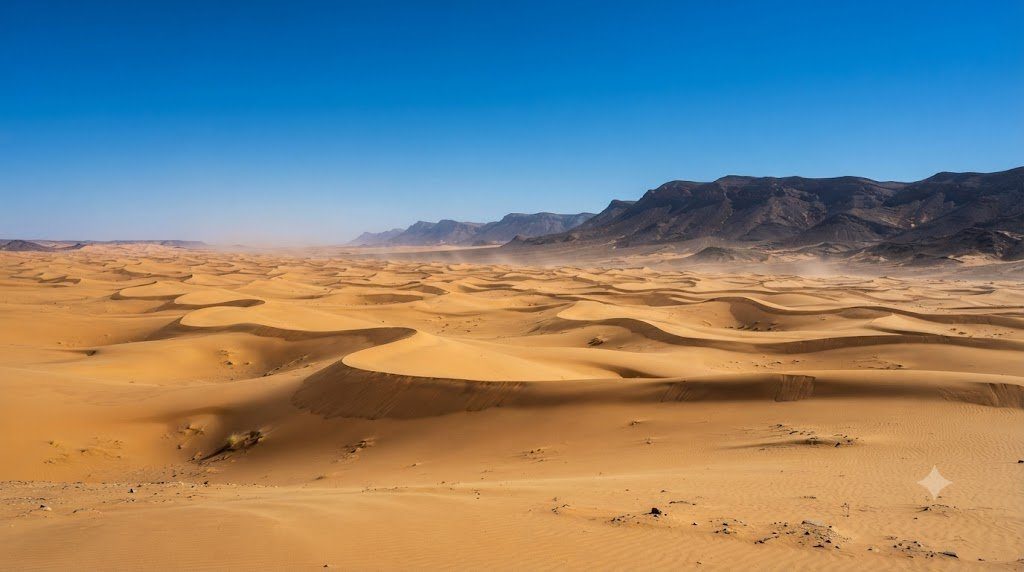
- BWh (Hot Desert Climate): $T_{\text{ann}} \ge 18^\circ\text{C}$. The classic scorching subtropical deserts of Earth (Sahara, Arabian, Rub’ al Khali, Sonoran, and interior Australian deserts). Summer afternoon temperatures routinely exceed 45°C to 50°C under cloudless skies, while nocturnal radiational cooling drives diurnal temperature swings of 20°C to 25°C. High sensible heat flux drives dust devil formation and intense thermal updrafts.
- BWk (Cold Desert Climate): $T_{\text{ann}} < 18^\circ\text{C}$. Mid-latitude interior deserts situated far from oceans or shielded behind colossal mountain rain-shadow barriers (Gobi Desert of Mongolia, Taklamakan of China, Patagonia of Argentina, Great Basin of North America). Characterized by blistering hot summers but severe, sub-zero continental freezing winters with snowpack.
- BSh (Hot Semi-Arid Steppe): $T_{\text{ann}} \ge 18^\circ\text{C}$. Transition zones buffering hot deserts from humid savannas (the African Sahel, the Australian outback fringes, semi-arid regions of northwestern India). Supports short drought-tolerant bunchgrasses and pastoral nomadism. Highly vulnerable to desertification.
- BSk (Cold Semi-Arid Steppe): $T_{\text{ann}} < 18^\circ\text{C}$. Expansive continental temperate grasslands (the North American Great Plains, the Eurasian Steppes of Ukraine and Kazakhstan, interior Anatolia). The historical breadbaskets of world dryland wheat farming.
5. Group C: Temperate Mesothermal Taxonomy (Cfa, Cfb, Cfc, Csa, Csb, Cwa)
Group C temperate climates are characterized by moderate winter cold and are subdivided by precipitation seasonality (second letter) and summer warmth (third letter):
- The Mediterranean Climates (Csa / Csb – Dry Summer): Summer is distinctly dry, with the driest summer month receiving less than 30 mm (or 40 mm) of rain and less than one-third the precipitation of the wettest winter month.
- Csa (Hot-Summer Mediterranean): Warmest month averages $\ge 22^\circ ext{C}$. Found across the Mediterranean Basin, central California, and southwestern Australia. Fosters sclerophyllous evergreen maquis and chaparral vegetation adapted to summer moisture stress (olive trees, cork oaks, scrub).
- Csb (Warm-Summer Mediterranean): Warmest month averages $< 22^\circ ext{C}$ with at least four months $\ge 10^\circ ext{C}$. Buffered by cold coastal ocean currents (San Francisco, coastal Oregon, central coastal Chile, Cape Town). Frequent coastal fog suppresses summer temperatures.
- Humid Subtropical Climates (Cfa / Cwa): Warmest month averages $\ge 22^\circ ext{C}$ with year-round rain (Cfa) or dry winter (Cwa). Located on eastern continental margins (southeastern United States, southeastern China, the Pampas of Argentina). Driven by maritime tropical air pumping abundant moisture from warm ocean currents (Gulf Stream, Kuroshio). Fosters dense mixed broadleaf and pine forests.
- Oceanic / Maritime Climates (Cfb / Cfc): Year-round rain, mild winters, and cool summers ($T_{\text{warmest}} < 22^\circ\text{C}$). Dominates Western Europe (UK, Ireland, France, Germany), coastal Pacific Northwest, and New Zealand. Driven by persistent prevailing westerlies off temperate oceans. High cloud cover, frequent drizzle, and lush perennial pastures.
6. Group D: Continental Microthermal Taxonomy (Dfa, Dfb, Dfc, Dfd, Dwa, Dwb)
Group D continental climates are defined by severe winter freezing and wide annual temperature ranges, existing almost exclusively in the vast landmasses of North America and Eurasia:
- Dfa / Dwa (Hot-Summer Humid Continental): Coldest month averages $\le -3^\circ ext{C}$, but warmest month exceeds $\ge 22^\circ ext{C}$. The core climate of the American Midwest (Iowa, Illinois, Chicago) and the Danubian Plain. Boasts blistering hot, humid summers driven by Gulf air masses, and frigid winters with heavy blizzards. Supports high-yielding maize and soybean agriculture on fertile Mollisol soils.
- Dfb / Dwb (Warm-Summer Continental / Hemiboreal): Coldest month $\le -3^\circ ext{C}$, warmest month $< 22^\circ ext{C}$ with at least four months $\ge 10^\circ ext{C}$. Encircles the Great Lakes, northern New England, southern Canada, Poland, and western Russia. Home to the northern hardwood-conifer transition forests (maple, beech, birch, hemlock).
- Dfc / Dwc / Dsc (Subarctic / Boreal Taiga): Only one to three months average above $+10^\circ ext{C}$. Winters are long, dark, and bitterly cold, lasting 6 to 8 months. Dominates the vast interior taiga forests of Alaska, northern Canada, Scandinavia, and Siberia. Supports dense monocultures of needleleaf conifers (spruce, fir, larch) adapted to physiological drought in frozen soils.
- Dfd / Dwd (Extremely Severe Subarctic Taiga): Coldest month averages $\le -38^\circ ext{C}$ ($-36.4^\circ ext{F}$)! Encountered only in northeastern Siberia (Verkhoyansk and Oymyakon, “The Cold Poles of the Inhabited World”). Winter surface temperatures routinely plunge below -60°C under massive Siberian Anticyclones, producing annual temperature swings exceeding an astonishing 100 degrees Celsius between summer and winter!
7. Group E: Polar and Alpine Hekistothermal Taxonomy (ET and EF)
Group E polar climates represent the cryogenic frontier of planetary climatology, where annual solar energy is insufficient to support arboreal tree growth:
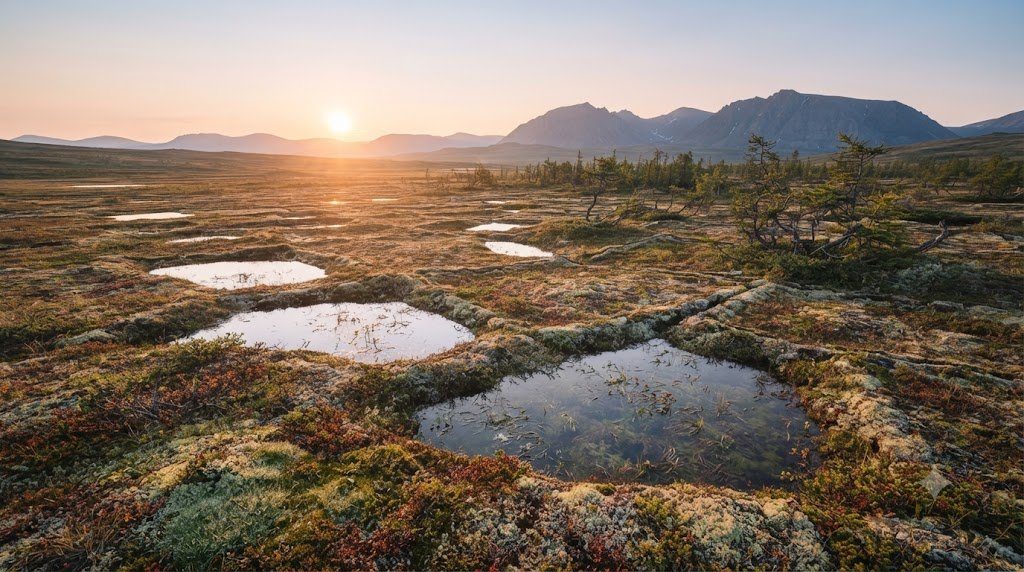
- ET (Tundra Climate): The warmest month of the year has an average temperature between $0^\circ\text{C}$ and $+10^\circ\text{C}$ ($32^\circ\text{F}\text{ to }50^\circ\text{F}$). Characterized by continuous or discontinuous subterranean permafrost. During the brief 6- to 8-week summer, the top few centimeters of soil thaw, creating a soggy surface marshland supporting low-lying mosses, lichens, sedges, and dwarf willows. Trees cannot grow because root xylem tissues cannot survive in the frozen permafrost subsoil. Covers the northern rims of North America and Eurasia, the Tibetan Plateau, and sub-Antarctic islands.
- EF (Ice Cap Climate): The mean temperature of every single month of the entire year is $\le 0^\circ ext{C}$ ($32^\circ ext{F}$). Permanent cryogenic freezing. The landscape is buried beneath kilometers of eternal continental ice. Encompasses the interior of the Greenland Ice Sheet and the entire Antarctic continent, where the lowest natural surface temperature ever recorded on Earth was logged at Vostok Station: $-89.2^\circ ext{C}$ ($-128.6^\circ ext{F}$). Precipitation falls exclusively as crystalline diamond dust, making the Antarctic ice cap one of the driest physical deserts on Earth!
8. The 30 Official Köppen-Geiger Climate Classes: Comprehensive Matrix
The following master taxonomic matrix synthesizes all 30 standard Köppen-Geiger climate classes, their defining empirical criteria, and their global geographic biome distributions:
| Köppen Code | Formal Classification | Primary Temperature Criteria | Precipitation Seasonality Criteria | Representative Global Geographic Locations |
|---|---|---|---|---|
| Af | Tropical Rainforest | All months >= 18°C | All months precipitation >= 60 mm | Manaus (Brazil), Singapore, Kisangani (Congo) |
| Am | Tropical Monsoon | All months >= 18°C | Driest month < 60 mm, but P_ann >= 25(100 – P_dry) | Miami (USA), Chittagong (Bangladesh), Yangon (Myanmar) |
| Aw / As | Tropical Savanna | All months >= 18°C | Driest month < 60 mm, P_ann < 25(100 - P_dry) | Brasilia (Brazil), Lagos (Nigeria), Darwin (Australia) |
| BWh | Hot Desert | T_ann >= 18°C | P_ann < 0.5 * P_threshold | Cairo (Egypt), Las Vegas (USA), Riyadh (Saudi Arabia) |
| BWk | Cold Desert | T_ann < 18°C | P_ann < 0.5 * P_threshold | Turpan (China), Damascus (Syria), Reno (USA) |
| BSh | Hot Semi-Arid | T_ann >= 18°C | 0.5 * P_threshold <= P_ann < P_threshold | Niamey (Niger), Monterrey (Mexico), Jaipur (India) |
| BSk | Cold Semi-Arid | T_ann < 18°C | 0.5 * P_threshold <= P_ann < P_threshold | Denver (USA), Madrid (Spain), Ulaanbaatar (Mongolia) |
| Cfa | Humid Subtropical | -3°C <= T_cold < 18°C, T_warm >= 22°C | No dry season (fully humid) | Atlanta (USA), Shanghai (China), Buenos Aires (Argentina) |
| Cfb | Oceanic / Marine | -3°C <= T_cold < 18°C, 4 mos >= 10°C | No dry season, T_warm < 22°C | London (UK), Vancouver (Canada), Melbourne (Australia) |
| Cfc | Subpolar Oceanic | -3°C <= T_cold < 18°C, 1-3 mos >= 10°C | No dry season, T_warm < 22°C | Reykjavik (Iceland), Ushuaia (Argentina), Torshavn (Faroe) |
| Csa | Hot-Summer Mediterranean | -3°C <= T_cold < 18°C, T_warm >= 22°C | Dry summer (P_sdry < 30 mm, < P_wwet / 3) | Rome (Italy), Athens (Greece), Los Angeles (USA) |
| Csb | Warm-Summer Mediterranean | -3°C <= T_cold < 18°C, 4 mos >= 10°C | Dry summer, T_warm < 22°C | San Francisco (USA), Porto (Portugal), Cape Town (SA) |
| Dfa | Hot-Summer Continental | T_cold <= -3°C, T_warm >= 22°C | No dry season (humid continental) | Chicago (USA), Bucharest (Romania), Beijing (China) |
| Dfb | Warm-Summer Continental | T_cold <= -3°C, 4 mos >= 10°C | No dry season, T_warm < 22°C | Toronto (Canada), Moscow (Russia), Stockholm (Sweden) |
| Dfc | Subarctic Taiga | T_cold <= -3°C, 1-3 mos >= 10°C | No dry season, severe winter | Anchorage (USA), Yellowknife (Canada), Arkhangelsk (Russia) |
| Dfd | Extremely Cold Subarctic | T_cold <= -38°C, 1-3 mos >= 10°C | No dry season, extreme Siberian winter | Yakutsk (Russia), Verkhoyansk (Russia) |
| ET | Polar Tundra | 0°C <= T_warmest < 10°C | Permafrost, tree growth physically impossible | Nuuk (Greenland), Longyearbyen (Svalbard), Barrow (USA) |
| EF | Polar Ice Cap | All months T_warmest <= 0°C | Perpetual ice and snowpack, cryogenic | Vostok Station (Antarctica), McMurdo, Summit (Greenland) |
9. Bioclimatic Vegetation Boundaries and Holdridge Life Zones
While Köppen utilized monthly empirical parameters, American ecologist Leslie Holdridge expanded bioclimatic taxonomy in 1947 with the Holdridge Life Zones System, incorporating physical thermodynamics:
Holdridge plotted global biomes across a logarithmic triangular coordinate system defined by three bioclimatic axes:
- Biotemperature ($T_{bio}$): Calculated by summing all hourly or daily temperatures between 0°C and 30°C and dividing by total hours in the year (temperatures below 0°C are treated as 0°C because physiological biochemical growth ceases, and temperatures above 30°C are capped due to heat inactivation of plant enzymes).
- Mean Annual Precipitation: Logarithmic rainfall axis ranging from 62.5 mm to > 8,000 mm.
- Potential Evapotranspiration Ratio (PER): Defined as $\text{PER} = \text{PET} / P = (58.93 \times T_{bio}) / P$. When $\text{PER} > 1.0$, evaporation exceeds rainfall, classifying the regime as semi-arid or arid; when $\text{PER} < 1.0$, the climate is humid or pluvial.
The convergence of Holdridge’s mathematical system with Köppen-Geiger confirms that global vegetation zones—from tropical wet forest to alpine nival deserts—are fundamentally thermodynamic constructs governed by the coupled energy and water balance.
10. Contemporary Shifts: How Global Warming is Redrawing Climate Boundaries
In the Anthropocene, the Köppen-Geiger climate map is not a static historical atlas; it is actively warping and migrating across continental landmasses in response to rising global mean temperatures:
Recent high-resolution climatological reanalyses (Beck et al., 2018; Rubel & Kottek, 2010) document profound geographical shifts:
- The Poleward March of Arid Climates (Group B Expansion): Semi-arid BSk and BSh steppe climates are encroaching rapidly into former temperate Csa and Cfa zones. In the Mediterranean and the western United States, aridification is expanding dryland boundaries by up to 100 to 200 kilometers per century.
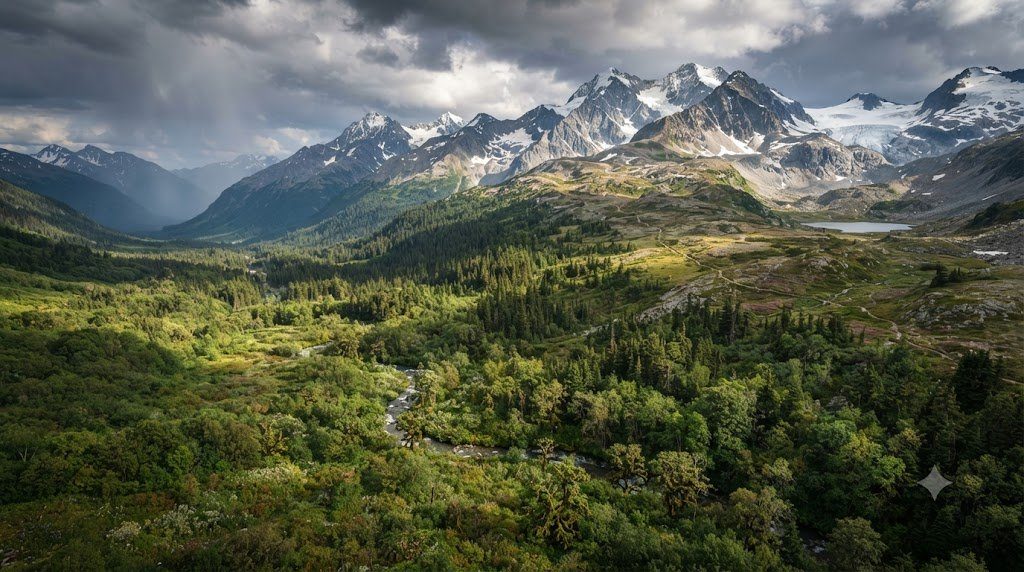
- The Contraction and Upward Retreat of Alpine Tundra (ET): As temperatures rise in high-elevation mountain chains (the European Alps, the Rockies, the Himalayas), the 10°C summer isotherm is climbing toward mountain peaks at rates of 10 to 30 meters per decade. Alpine tundra is being physically squeezed off mountain peaks—a phenomenon known as the “Mountain Top Extinction Trap.”
- Subarctic Taiga (Dfc) Transforming into Warm Continental (Dfb): Across southern Canada, Scandinavia, and western Siberia, milder winters are expanding Dfb climates northward, enabling agricultural grain cultivation in former boreal forest zones, while thawing underlying discontinuous permafrost and causing infrastructure subsidence.