CLIMATE GEOGRAPHY OBSERVATORY · EARTH SCIENCE
Same Latitude. Different Weather. Why?
Discover why living beside the ocean can feel completely different from living hundreds of miles inland—even when both places receive similar amounts of sunlight.
Two cities can sit at nearly the same latitude yet experience surprisingly different climates.
One may have mild winters, cool summers, and frequent cloudy days.
The other may experience freezing winters, hot summers, and much larger temperature changes throughout the year.
Why does this happen?
Latitude influences how much solar energy a location receives, but it is only one part of the climate system.
Distance from the ocean also matters.
Large bodies of water absorb, store, and release heat differently from land.
Winds, ocean currents, mountains, and atmospheric circulation further influence local conditions.
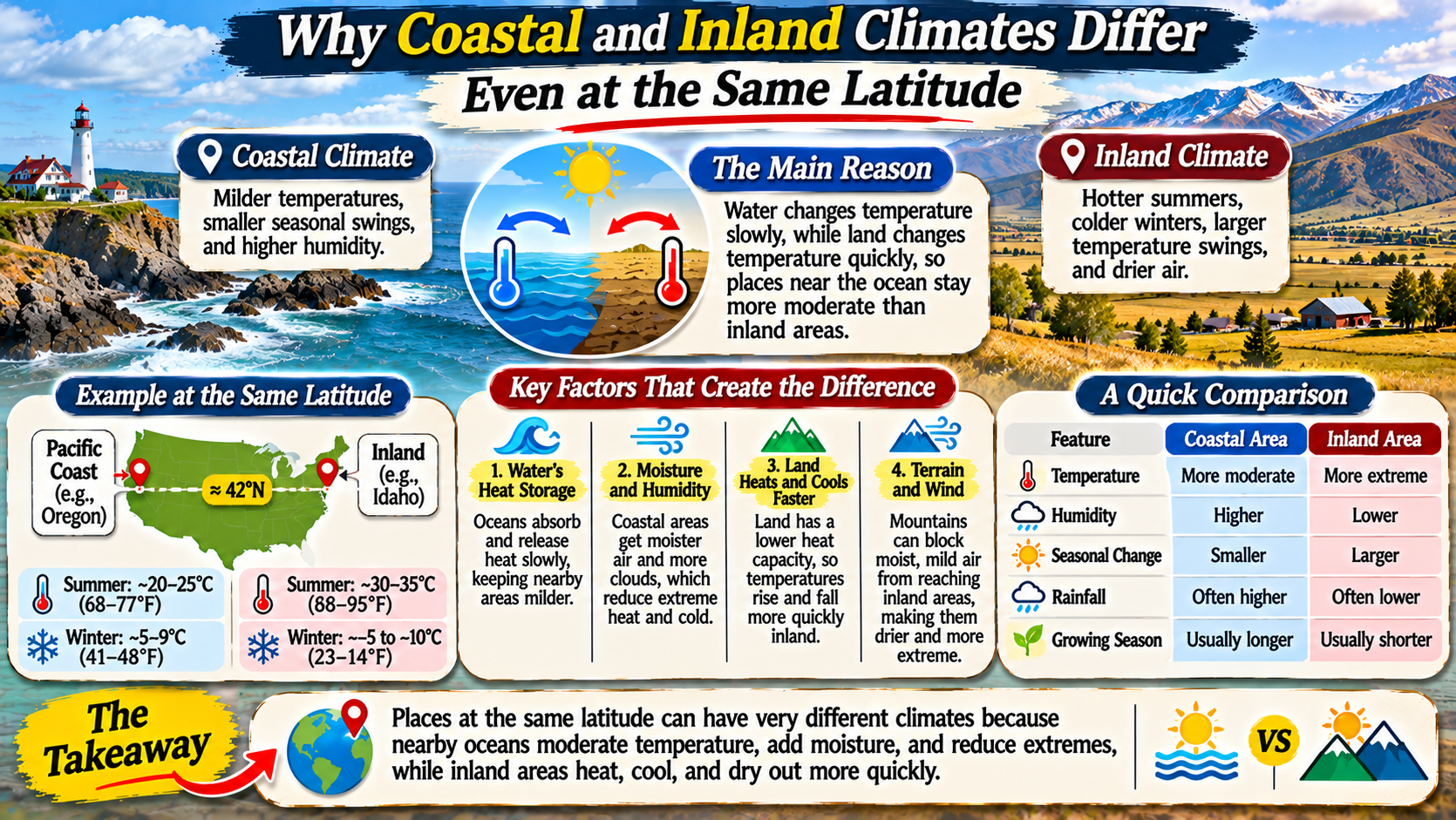
Coastal climates are often moderated by nearby oceans, while inland climates generally experience greater seasonal temperature extremes.
Understanding this difference helps explain weather patterns across North America, Europe, and many other parts of the world.
What Does Latitude Tell Us About Climate?
Latitude describes how far a location lies north or south of the equator.
It strongly influences the angle of incoming sunlight and the seasonal length of daylight.
Locations near the equator generally receive more direct sunlight throughout the year.
Higher latitudes experience larger seasonal changes in sunlight.
However, latitude does not determine climate by itself.
Elevation, ocean proximity, prevailing winds, ocean currents, and regional geography all influence temperature and precipitation.
This explains why two places on the same latitude line may have very different weather patterns.
The Biggest Difference: Land and Water Heat at Different Rates
The most important reason coastal and inland climates differ is that land and water respond differently to incoming energy.
Land surfaces often warm relatively quickly under sunlight.
They can also lose heat rapidly after sunset or during colder seasons.
Large bodies of water usually change temperature more slowly.
This happens partly because water has a high specific heat capacity.
In simple terms, it takes a substantial amount of energy to raise the temperature of a given mass of water.
Ocean mixing also spreads heat through a larger volume, while evaporation transfers energy away from the surface.
As a result, the ocean acts as a large reservoir of thermal energy.
It absorbs heat during warmer periods and releases stored heat during cooler periods.
This moderating effect can strongly influence nearby coastal areas.
CLIMATE MECHANISM / SURFACE HEATING
Why Coastal Areas Often Have Milder Winters
During autumn and winter, land temperatures can fall quickly as incoming solar energy decreases.
Ocean water usually cools more gradually.
Because the ocean retains heat from previous warmer months, it may remain relatively warm compared with nearby land.
When winds carry marine air inland, that air can moderate coastal temperatures.
This often produces winters that are less severe than those experienced farther inland at similar latitudes.
For example, many coastal areas of western Europe have relatively mild winters compared with continental interiors at comparable latitudes.
However, this pattern depends on prevailing winds and ocean currents.
A coastline exposed to cold ocean currents or polar air may still experience cold conditions.
Why Inland Areas Often Have Hotter Summers
In summer, land surfaces can heat rapidly under strong sunlight.
Without the nearby ocean’s moderating influence, inland areas may experience higher daytime temperatures.
Large continental interiors can also develop extended periods of hot weather.
By contrast, coastal areas exposed to cooler marine air may remain noticeably cooler.
Ocean breezes and marine cloud layers can further reduce daytime heating in some locations.
However, not every coastline has cool summers.
Warm ocean currents, humidity, and regional wind patterns can produce hot coastal conditions.
The general principle is that proximity to a large body of water tends to reduce temperature extremes, not eliminate them.
Maritime and Continental Climates Explained
Geographers often describe the influence of oceans using the terms maritime and continental.
A maritime climate is strongly influenced by nearby water.
It commonly has a smaller annual temperature range and may experience relatively mild winters and cooler summers.
A continental climate is more strongly influenced by land surfaces.
It often has a larger annual temperature range, including colder winters and warmer summers.
These categories describe broad climate characteristics rather than rigid rules.
Mountain ranges, atmospheric circulation, and ocean currents can produce important exceptions.
| Climate Feature | Coastal / Maritime | Inland / Continental |
|---|---|---|
| Summer temperatures | Often moderated by marine air | Often hotter in warm seasons |
| Winter temperatures | Often milder | Often colder |
| Annual temperature range | Generally smaller | Generally larger |
| Humidity | Often influenced by marine moisture | Varies with regional conditions |
| Precipitation | Affected by moisture-bearing winds | Strongly dependent on regional circulation |
| Daily temperature changes | Often smaller near the shoreline | Can be larger, especially in dry areas |
How Sea Breezes Change Coastal Weather
Sea breezes are local winds caused by temperature differences between land and water.
During a sunny day, the land often warms faster than the adjacent sea.
Air above the warmer land becomes less dense and rises.
Relatively cooler air from over the water can then move toward the coast near the surface.
This movement creates a sea breeze.
Sea breezes can lower afternoon temperatures near the shoreline.
They may also influence humidity, cloud formation, and local weather conditions.
At night, the temperature contrast can reverse.
Under suitable conditions, cooler air over land may move toward the water, producing a land breeze.
These local circulations are particularly noticeable when larger-scale winds are relatively weak.
Ocean Currents Can Warm or Cool Coastal Regions
Ocean currents transport water and heat across large distances.
Warm currents can help maintain relatively mild conditions along certain coastlines.
Cold currents can cool nearby air and influence coastal cloudiness or fog.
The effects depend on the interaction between ocean temperatures and prevailing winds.
For example, the North Atlantic’s ocean circulation contributes to the transfer of heat toward higher latitudes.
Combined with atmospheric circulation, this helps explain why parts of western Europe have relatively mild climates.
Along portions of the California coast, cool ocean water and coastal upwelling can contribute to lower summer temperatures and marine fog.
Ocean currents therefore help explain why two coastal locations at similar latitudes may still have different climates.
Why Coastal Areas Are Often More Humid
Oceans provide a major source of atmospheric moisture through evaporation.
When air moves over warm or cool ocean surfaces, it can gain or lose moisture depending on conditions.
Coastal areas frequently receive marine air that influences humidity.
However, relative humidity depends on both moisture content and air temperature.
A cool coastal city may have high relative humidity without feeling as hot as a warm inland city.
Likewise, some inland regions experience very humid summers because of moisture transported by large-scale winds.
Distance from the ocean alone does not determine humidity.
Wind direction, temperature, vegetation, and regional moisture sources all matter.
Why Rainfall Can Differ at the Same Latitude
Precipitation patterns depend on atmospheric moisture and the processes that cause air to rise and cool.
Coastal areas exposed to moisture-bearing winds may receive frequent rainfall.
However, some coastal regions are surprisingly dry.
Cold ocean currents, persistent high-pressure systems, and regional atmospheric circulation can limit rainfall.
Inland locations may receive moisture from distant oceans, large lakes, or seasonal weather systems.
Therefore, it is inaccurate to assume that every coastal location is wetter than every inland location.
The relationship depends on geography and circulation patterns.
Mountains Can Strengthen Climate Differences
Mountain ranges can influence how far marine air travels inland.
When moist air encounters mountains, it may be forced upward.
As the air rises, it expands and cools.
This can encourage condensation and precipitation on windward slopes.
After crossing the mountains, descending air may become warmer and drier.
This creates a rain-shadow effect.
Mountain barriers can also reduce the direct influence of marine air on inland valleys and plains.
As a result, two locations at similar latitudes may experience different temperatures and rainfall patterns because one is exposed to the ocean while the other lies behind a mountain range.
GEOGRAPHY OBSERVATION
Distance from the Ocean Matters—but Wind Direction and Mountains Determine How Strongly It Matters.
A coastal location exposed to prevailing marine winds may experience a stronger maritime influence than another location equally close to the sea but sheltered by terrain or affected by different winds.
Real-World Example: San Francisco and Inland California
California provides a useful illustration of coastal climate moderation.
San Francisco is influenced by the nearby Pacific Ocean.
Cool marine air, coastal fog, and regional winds help moderate summer temperatures.
Farther inland, parts of California’s Central Valley often experience much hotter summer afternoons.
The difference can be substantial even across relatively short geographic distances.
The ocean acts as a cooling influence near the coast, while inland areas are more directly affected by heating over land.
Terrain and regional wind patterns also contribute to the contrast.
This example demonstrates why distance from the coastline can matter even when latitude changes very little.
Real-World Example: Western Europe and Continental Interiors
Western Europe provides another important example.
Many Atlantic-facing locations experience relatively moderate seasonal temperatures.
The nearby ocean and prevailing atmospheric circulation help reduce some winter temperature extremes.
Farther inland, continental regions often experience colder winters and larger annual temperature ranges.
Oceanic influence becomes weaker with distance, although the transition is gradual and shaped by regional geography.
Elevation, local winds, and the movement of air masses can produce additional differences.
Latitude remains important, but ocean influence helps explain why similar latitudes do not guarantee similar climates.
Does Distance from the Ocean Always Determine Climate?
No.
Distance from the ocean is an important factor, but it does not operate independently.
Some inland regions are influenced by large lakes, which can moderate local temperatures and affect snowfall or rainfall.
High-elevation coastal locations may be cooler than nearby lowland areas.
Deserts can occur near coastlines under suitable atmospheric and oceanic conditions.
Prevailing winds may carry maritime air hundreds of miles inland in some regions.
In other places, mountain barriers limit that influence.
Climate results from several interacting processes rather than one geographic measurement.
How to Compare Two Locations at the Same Latitude
To understand why two locations have different climates, examine several characteristics together.
CLIMATE ANALYSIS / FIVE QUESTIONS
Consider whether marine air can reach the area easily.
Onshore winds can carry marine conditions inland.
Ocean temperatures influence the air above them.
Terrain can create strong temperature and precipitation contrasts.
Compare average temperatures in the warmest and coldest months.
Why These Climate Differences Matter
Coastal and inland climate differences influence agriculture, building design, transportation, and everyday life.
Farmers must consider growing-season length, frost risk, and seasonal rainfall.
Buildings may require different heating, cooling, or moisture-control strategies depending on local conditions.
Coastal environments can experience salt exposure and marine humidity.
Inland regions may face larger temperature swings and different seasonal hazards.
Natural ecosystems also respond to climate differences.
Plant communities, soil moisture, and wildlife habitats vary according to temperature and precipitation patterns.
Understanding maritime and continental influences therefore helps explain both human settlement and environmental diversity.
Frequently Asked Questions
Why are coastal climates often milder than inland climates?
Large bodies of water change temperature more slowly than land, helping moderate nearby air temperatures.
Why do inland areas often have colder winters?
Land surfaces can cool rapidly, and inland locations generally receive less direct moderation from nearby oceans.
Does the ocean make coastal summers cooler?
Often, yes. Cooler marine air can moderate summer temperatures, although regional currents and weather patterns create exceptions.
Are coastal areas always more humid?
No. Coastal areas are influenced by marine moisture, but humidity also depends on temperature, winds, and regional atmospheric conditions.
What is the difference between maritime and continental climates?
Maritime climates are strongly influenced by nearby water and often have smaller annual temperature ranges. Continental climates generally experience larger seasonal temperature differences.
Can two cities at the same latitude have different rainfall?
Yes. Ocean currents, prevailing winds, mountains, and atmospheric circulation can produce major precipitation differences.
Why is San Francisco cooler than inland California in summer?
Cool Pacific waters, marine air, coastal fog, and regional wind patterns help moderate temperatures near San Francisco, while inland valleys often heat more strongly.
Final Thoughts
Latitude helps determine the amount and seasonal pattern of sunlight a location receives.
However, it cannot explain every difference in climate.
Coastal areas are influenced by the enormous heat-storage capacity of nearby oceans.
This often reduces seasonal temperature extremes and affects local winds, humidity, and cloud formation.
Inland regions are generally more strongly influenced by land surfaces, which can heat and cool rapidly.
Ocean currents, prevailing winds, mountains, and regional weather systems add further complexity.
As a result, two places at nearly the same latitude can experience very different summers, winters, and rainfall patterns.
Understanding the contrast between maritime and continental climates provides a useful foundation for studying weather, geography, and Earth’s climate system.
The next time you compare two cities on a map, remember that their distance from the ocean may tell you almost as much about their climate as their latitude.