🌍 Planetary Geophysical Fluid Dynamics & Atmospheric Circulation
An exhaustive geophysical fluid dynamics dissertation on Earth’s general atmospheric circulation. We derive the conservation of absolute angular momentum on a rotating oblate spheroid, analyze thermal direct Hadley cell overturning, baroclinic instability driving the Ferrel cell, polar vortex thermodynamics, Coriolis deflection kinematics, and the seasonal latitudinal migration of the Intertropical Convergence Zone (ITCZ).
Planet Earth is a thermodynamic heat engine operating under the inexorable laws of physics. Because our planet is a rotating oblate spheroid tilted at an axial obliquity of 23.44 degrees relative to its orbital plane, solar insolation is distributed with extreme spatial inequality across the globe. The equatorial tropics receive an immense, continuous surplus of incoming shortwave solar radiation—absorbing vastly more energy than they can radiate back into space. Conversely, the high-latitude polar regions experience an insurmountable annual radiative deficit, radiating far more longwave infrared energy into space through the clear, frigid troposphere than they receive from the glancing polar sun.
If the Earth possessed neither an atmosphere nor oceans, this stark radiative imbalance would drive the equatorial tropics into an unlivable thermal inferno exceeding 60 degrees Celsius, while plunging the mid-latitudes and poles into a permanent, cryogenic deep freeze. However, our planet maintains habitable temperatures across broad latitudes through General Atmospheric Circulation and coupled oceanic conveyor systems. The atmosphere operates as a gigantic planetary fluid heat transport mechanism, perpetually pumping millions of terawatts of sensible and latent heat poleward away from the sun-drenched equator toward the frigid poles.
In this comprehensive atmospheric physics monograph, we dissect the three-cell general circulation model—the tropical Hadley Cell, the mid-latitude Ferrel Cell, and the high-latitude Polar Cell. We derive the physical mathematics of Coriolis acceleration, explore baroclinic eddy wave transport, and trace the climatic life cycle of the Intertropical Convergence Zone (ITCZ).
1. The Planetary Radiative Energy Imbalance: Solar Insolation and Heat Transport
The fundamental driver of all atmospheric motion begins with the Top-of-Atmosphere (TOA) Net Radiative Flux. Solar irradiance ($S_0 \approx 1,361\text{ W/m}^2$) strikes the Earth as a geometric solar beam. Because the spherical Earth intercepts this beam as a circular disc of cross-sectional area $\pi R^2$ but distributes the energy across a total rotating spherical surface area of $4\pi R^2$, the global average incoming solar flux is:
F_{\text{solar}} = \frac{S_0}{4} (1 – \alpha) \approx \frac{1361}{4} (1 – 0.30) \approx 238\text{ W/m}^2
Where $\alpha \approx 0.30$ represents the Earth’s planetary albedo. However, this radiative energy is intensely concentrated across equatorial latitudes:
- The Tropical Energy Surplus (0 to 35 Degrees Latitude): Near the equator, the sun stands high near the zenith throughout the year, projecting incoming solar radiation across a compact horizontal surface area with minimal atmospheric path attenuation. Incoming absorbed solar radiation averages 300 to 350 W/m², while outgoing longwave radiation (OLR) escaping to space is throttled by dense atmospheric water vapor and high cloud canopies to roughly 220 to 250 W/m². This creates a permanent net positive energy surplus.
- The High-Latitude Energy Deficit (35 to 90 Degrees Latitude): As latitude increases, the solar zenith angle increases; solar rays strike the surface at glancing oblique angles, spreading solar energy over a vastly larger surface area while traversing an elongated atmospheric optical path. Furthermore, highly reflective polar ice and snowpack ($\\alpha > 0.60\text{ to }0.85$) reflect incoming sunlight straight back into space. Net outgoing longwave radiation exceeds incoming absorbed solar energy, resulting in a severe, chronic net energy deficit poleward of 35° latitude.
- Poleward Meridional Energy Flux: To satisfy the First Law of Thermodynamics, the atmosphere and ocean transport approximately 5.5 Petawatts ($5.5 \times 10^{15}\text{ Watts}$) of heat poleward across each hemisphere’s mid-latitudes. The atmosphere accomplishes approximately 78% of this total planetary heat transport (predominantly via latent heat flux of water vapor and baroclinic transient eddies), while ocean currents transport the remaining 22%.
2. Coriolis Acceleration Kinematics on a Rotating Oblate Spheroid
If Earth were completely stationary without axial rotation, atmospheric heat transport would operate as a simple, single hemispheric convection cell: warm air would rise at the equator, travel uninterrupted to the poles at high altitudes, sink over the cold ice caps, and return equatorward along the surface as a gentle north wind in the Northern Hemisphere. However, Earth rotates continuously around its polar axis from west to east with an angular velocity of $\Omega = 7.2921 \times 10^{-5}\text{ radians per second}$.
Within this rotating non-inertial frame of reference, any parcel of air traveling across lines of latitude experiences an apparent steering force termed the Coriolis Acceleration:
\vec{a}_{\text{Coriolis}} = -2 \vec{\Omega} \times \vec{v}
Decomposing this vector equation into horizontal geographical coordinates on a sphere of latitude $\phi$, the horizontal Coriolis acceleration components are:
\frac{du}{dt}_{\text{Coriolis}} = 2\Omega v \sin \phi = f v, \qquad \frac{dv}{dt}_{\text{Coriolis}} = -2\Omega u \sin \phi = -f u
Where $f = 2\Omega \sin \phi$ is the fundamental Coriolis Parameter. The kinematic consequences of Coriolis dynamics dictate global meteorology:
- Deflection Direction: In the Northern Hemisphere ($f > 0$), moving air parcels are deflected continuously to their right relative to their direction of motion. In the Southern Hemisphere ($f < 0$), air parcels are deflected continuously to their left.
- Latitude Dependency: The Coriolis parameter vanishes completely at the Equator ($\sin 0^\circ = 0 \implies f = 0$), meaning air can cross isobars directly without rotational deflection. Coriolis deflection reaches its maximum strength at the North and South Poles ($\sin 90^\circ = 1 \implies f = 2\Omega$).
- Geostrophic Balance: In the free troposphere above the friction layer, the horizontal Pressure Gradient Force (PGF) pushing air from high to low pressure becomes exactly balanced by the opposing Coriolis force. This establishes Geostrophic Flow, forcing winds to blow parallel to isobars rather than flowing directly across them!
3. The Hadley Cell: Thermally Direct Overturning and Angular Momentum Conservation
Between the equator and approximately 30 degrees latitude in both hemispheres lies the giant tropical overturning circulation known as the Hadley Cell, named after British meteorologist George Hadley who first conceptualized the mechanism in 1735. The Hadley cell is a classic Thermally Direct Cell: warm, buoyant fluid rises in the heated equatorial zone and cold, dense fluid descends in the subtropical periphery.
The Equatorward Ascent and Deep Deep Convective Chimneys: Along the thermal equator, intense solar heating vaporizes vast quantities of seawater. Warm, moisture-saturated air converges at the surface, creating an expansive trough of low barometric pressure. As this humid air ascends, water vapor condenses into towering cumulonimbus clouds reaching heights of 15 to 18 kilometers into the tropical tropopause. The massive release of Latent Heat of Condensation (2.5 million Joules per kilogram of condensed water) fuels explosive buoyant acceleration, pumping billions of tons of air into the upper troposphere every second.
Conservation of Absolute Angular Momentum ($M$): As this ascended air turns poleward in the upper troposphere, it must obey the physical law of Conservation of Absolute Angular Momentum on a rotating sphere:
M = (u + \Omega R \cos \phi) R \cos \phi = \text{Constant}
Where $u$ is the zonal (east-west) wind speed, $R$ is planetary radius ($6,371\text{ km}$), and $\phi$ is latitude. At the equator ($\\phi = 0^\\circ$), the Earth’s surface rotates at a linear velocity of approximately $465\text{ m/s}$ ($1,674\text{ km/h}$). As the poleward-flowing air parcel moves from the equator toward higher latitudes, the radius of its rotation circle ($R \cos \phi$) shrinks rapidly. To conserve angular momentum, the air parcel’s eastward velocity ($u$) must accelerate explosively!
By the time the air parcel reaches 30° latitude, pure momentum conservation would theoretically accelerate the zonal wind to an astonishing $u = 134\text{ m/s}$ ($482\text{ km/h}$). Although turbulent friction and wave breaking temper this theoretical maximum, this eastward acceleration spawns the ferocious Subtropical Jet Stream at 12 to 14 km altitude, capping the poleward expansion of the Hadley cell.
4. The Subtropical Highs and the Planetary Desert Belts
By approximately 25 to 35 degrees latitude north and south, the poleward-moving upper tropospheric air can advance no further poleward due to hydrodynamic angular momentum constraints and radiational cooling. The air mass undergoes massive, continuous Dynamical Subsidence, sinking slowly back down toward the Earth’s surface.
As this upper tropospheric air sinks, it undergoes Adiabatic Compression: as barometric pressure increases from 200 hPa down to 1013 hPa, the air parcel is compressed and warms at the dry adiabatic lapse rate of 9.8°C per kilometer of descent! This compression warming produces profound meteorological effects:
- Relative Humidity Collapse: Sinking air warms rapidly, dramatically increasing its saturation vapor pressure. The relative humidity of the descending air plummets to single digits (often below 5% to 15%). Cloud formation becomes physically impossible, creating permanent skies of blazing, cloudless sunshine.
- The Subtropical High-Pressure Ridge: The massive weight of sinking air generates expansive, semi-permanent surface anticyclones: the Bermuda-Azores High, the Pacific High, the South Atlantic High, and the Indian Ocean High. These regions are characterized by light, variable winds historically referred to as the “Horse Latitudes.”
- The Global Desert Belts: The geographical footprints of this subtropical subsidence coincide precisely with the Earth’s most severe hyper-arid deserts: the Sahara, Arabian, Thar, Mojave, and Sonoran Deserts in the Northern Hemisphere, and the Atacama, Kalahari, Namib, and Great Australian Deserts in the Southern Hemisphere!
5. The Trade Winds: Surface Return Flow and Ekman Dynamics
Once the subsiding air reaches the surface within the subtropical anticyclones, it must flow outward toward areas of lower pressure. A major branch of this surface air flows back equatorward toward the equatorial low-pressure trough, closing the lower limb of the Hadley cell.
As this equatorward surface flow travels across the globe, it is deflected by the horizontal Coriolis force:
- In the Northern Hemisphere, equatorward winds (blowing from north to south) are deflected to their right, producing the persistent, steady Northeast Trade Winds blowing from the northeast toward the southwest.
- In the Southern Hemisphere, equatorward winds (blowing from south to north) are deflected to their left, generating the Southeast Trade Winds blowing from the southeast toward the northwest.
Because these oceanic winds blow with legendary consistency across thousands of miles of tropical ocean, they served as the historical nautical highways powering global trade during the Age of Sail. As the Trade Winds blow across tropical ocean basins, wind friction drives the surface water layer. Due to the Coriolis effect, the net transport of water (Ekman Transport) moves 90 degrees to the right of the wind in the Northern Hemisphere and 90 degrees to the left in the Southern Hemisphere. Along the equator, this divergence pulls cold, nutrient-rich deep ocean water to the surface, establishing the Equatorial Cold Tongue and fueling hyper-productive marine ecosystems.
6. The Intertropical Convergence Zone (ITCZ): The Thermal Equator’s Pulse
Where the Northeast Trade Winds of the Northern Hemisphere collide with the Southeast Trade Winds of the Southern Hemisphere in the equatorial trough, they establish the Intertropical Convergence Zone (ITCZ)—often visible on meteorological satellite imagery as a continuous, narrow, planet-girdling ribbon of ferocious deep convective storms.
Historically dreaded by sailors as the “Doldrums” due to its erratic surface wind calms punctuated by violent squalls and torrential downpours, the ITCZ is not stationary. It tracks the seasonal march of peak solar insolation:
- Boreal Summer Migration (June – August): As the Northern Hemisphere tilts toward the sun, peak continental heating shifts northward. Because landmasses possess a much lower specific heat capacity than oceans, the vast Eurasian and North African landmasses warm rapidly. The ITCZ migrates far north of the equator, reaching 15° to 25°N latitude across West Africa and South Asia, igniting the wet summer Asian and African Monsoons.
- Austral Summer Migration (December – February): As the solar zenith moves into the Southern Hemisphere, the thermal equator shifts south of the geographic equator, pulling the ITCZ down across northern Australia, the southern Amazon Basin, and southern Africa.
- Climatic Vulnerability: Subtle multi-decadal shifts in the mean latitudinal position of the ITCZ dictate life or death for billions of human beings. A southward displacement of the Atlantic ITCZ by barely 200 to 300 kilometers starved the African Sahel of summer monsoon rains during the 1970s and 1980s, triggering devastating famines.
7. The Ferrel Cell and the Dynamics of Mid-Latitude Baroclinic Waves
Between 30 degrees and 60 degrees latitude lies the mid-latitude circulation zone known as the Ferrel Cell, named after American meteorologist William Ferrel. Unlike the thermally direct Hadley and Polar cells, the Ferrel cell is an indirect, mechanically forced circulation:
In the Ferrel cell, cool air is forced to rise at its poleward boundary (near 60° latitude) while warm air is forced to sink at its equatorward boundary (near 30° latitude). If viewed purely as a mean zonal overturning circulation, the Ferrel cell appears to operate in thermodynamic reverse—consuming mechanical energy rather than releasing it! How does this counter-intuitive circulation persist?
The solution lies in Baroclinic Instability and Transient Synoptic Eddies:
- The Polar Front Temperature Gradient: In the mid-latitudes, warm subtropical air masses collide with cold, dense polar air masses along the Polar Front. This creates a severe horizontal temperature gradient ($\nabla_h T$). In geophysical fluid dynamics, an atmosphere where surfaces of constant pressure (isobars) intersect surfaces of constant density (isopycnals) is Baroclinic.
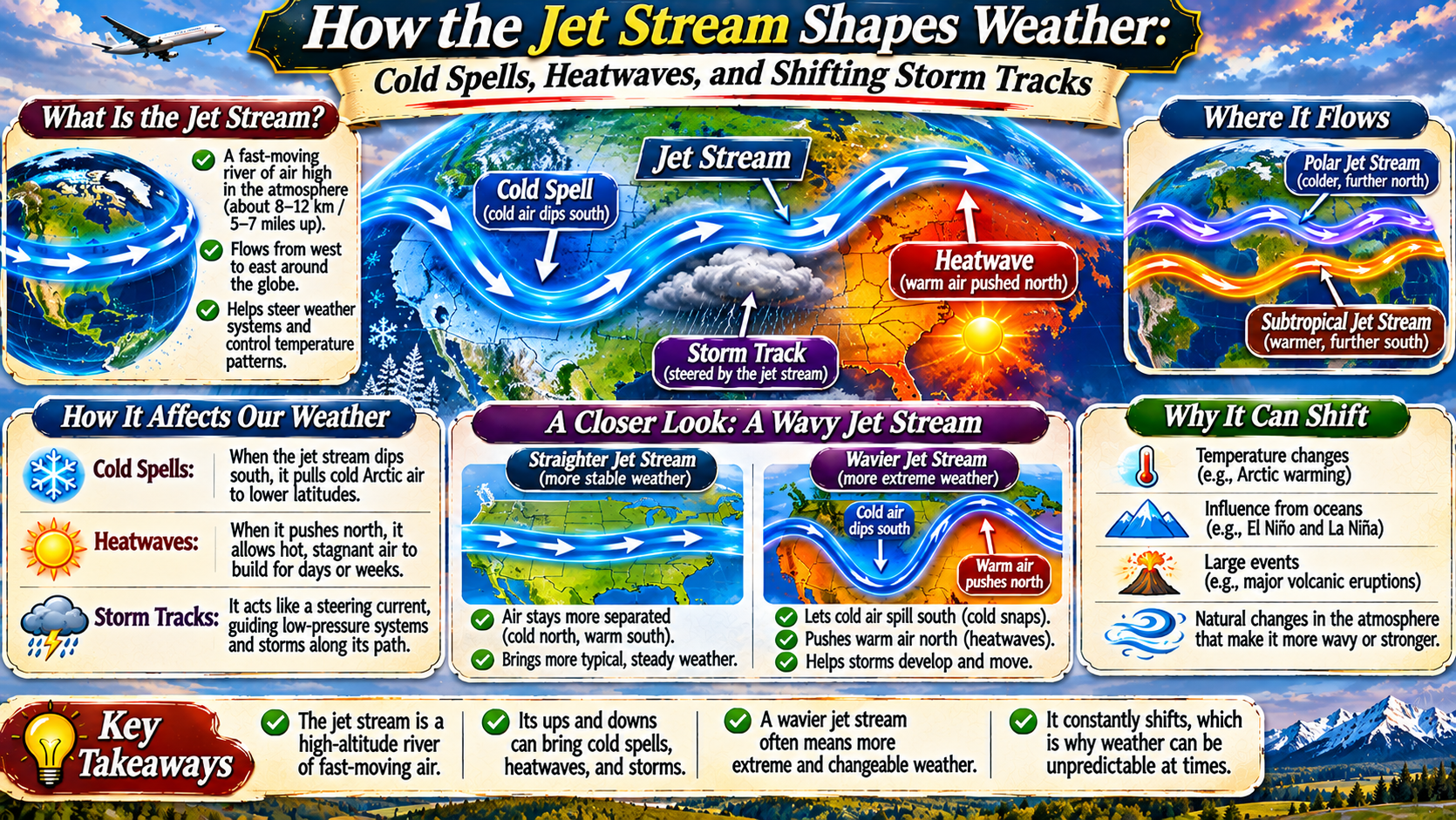
- Rossby Waves and Jet Stream Meanders: The intense thermal contrast across the polar front generates massive vertical wind shear through the Thermal Wind Relation:
\frac{\partial \vec{v}_g}{\partial \ln p} = -\frac{R_d}{f} \vec{k} \times \nabla_p T
This thermal wind fuels the ferocious Polar Front Jet Stream at 9 to 11 km altitude, blowing from west to east at speeds frequently exceeding 200 to 350 km/h. High-altitude hydrodynamic disturbances buckle this jet stream into planetary-scale sinusoidal meanders termed Rossby Waves.
- Extratropical Cyclones as Heat Engines: When Rossby waves amplify, they trigger baroclinic instability, spawning rotating extratropical low-pressure cyclones and migrating anticyclones. These migrating storms are the true workhorses of mid-latitude climatology: the warm sector of a cyclone pumps warm, humid subtropical air poleward, while the cold front drives frigid polar air equatorward. Synoptic storm systems accomplish over 90% of all poleward heat and momentum transport across the temperate zones!
8. The Polar Cell: Cryogenic Highs and the Circumpolar Vortex
The third and highest-latitude circulation component is the Polar Cell, operating between 60 degrees latitude and the geographic poles (90°N and 90°S). Like the Hadley cell, the Polar cell is thermally direct:
Over the ice sheets of Greenland, Antarctica, and the Arctic Basin, the surface radiates longwave energy into space through dry, frigid air. The air column cools intensely, contracts, and increases in density. This cold, heavy air descends over the pole, establishing persistent, dense Polar High-Pressure Anticyclones.
The Polar Easterlies: As this dense polar air spreads outward away from the high-pressure pole toward the subpolar low-pressure trough at 60° latitude, it is deflected by the Coriolis force: to the right in the north, and to the left in the south. This produces the frigid Polar Easterlies, sweeping cold winds from the northeast in the Arctic and from the southeast around Antarctica.
The Subpolar Low-Pressure Belt: Near 60° latitude, the cold, advancing Polar Easterlies slam into the warm, moisture-rich Westerlies flowing poleward from the subtropics. Because the dense polar air acts as a mechanical wedge, the warm air is forced to ramp upward over the cold dome. This continuous ascent generates the planetary Subpolar Low-Pressure Belt, marked by deep, storm-generating ocean basins: the Aleutian Low and Icelandic Low in the Northern Hemisphere, and the permanent Antarctic Circumpolar Storm Trough in the Southern Ocean.
9. Comparative Physical Dynamics of the Three General Circulation Cells
The following comparative matrix synthesizes the thermodynamic, aerodynamic, and geographic characteristics governing Earth’s three general circulation cells:
| Circulation Cell | Latitudinal Extent | Thermodynamic Mode | Dominant Surface Winds | Primary Vertical Motion | Key Climatic Phenomena |
|---|---|---|---|---|---|
| Hadley Cell | 0° to ~30° N / S | Thermally Direct (Warm rises, cool sinks) | Northeast & Southeast Trade Winds | Vigorous equatorial ascent; subtropical subsidence | ITCZ convective belts; equatorial rainforests; subtropical hyper-arid deserts |
| Ferrel Cell | ~30° to ~60° N / S | Thermally Indirect (Eddy-forced by storms) | Prevailing Westerlies (Mid-latitude westerlies) | Subtropical sinking; subpolar front ascent | Polar front jet stream; baroclinic Rossby waves; extratropical cyclones and blizzards |
| Polar Cell | ~60° to 90° N / S | Thermally Direct (Radiatively driven) | Polar Easterlies (Freezing arctic winds) | Cryogenic polar subsidence; subpolar low ascent | Polar vortex; ice cap anticyclones; katabatic winds; subpolar oceanic low basins |
10. Contemporary Shifts: Anthropogenic Hadley Cell Expansion and Jet Migration
In contemporary observational climatology, satellite radiometry and reanalysis data confirm that global warming is physically altering Earth’s circulation cells. The foremost planetary manifestation is The Poleward Expansion of the Hadley Cell (commonly referred to as Tropical Widening).
Over the past four decades, the descending branch of the Hadley cell has expanded poleward at an observed rate of 0.5 to 1.0 degree of latitude per decade in both hemispheres. The physical mechanisms driving this expansion include:
- Elevated Tropical Tropopause Height: Increased greenhouse gas radiative forcing warms the troposphere while cooling the stratosphere. The tropical tropopause has elevated by hundreds of meters, increasing static stability and allowing the upper-level poleward momentum flow to travel further poleward before hydrodynamic wave breaking triggers subsidence.
- Poleward Displacement of Mid-Latitude Storm Tracks: As the subtropical high-pressure dry zones expand toward the poles, they shove the prevailing westerlies and the polar front jet stream poleward. Regions located on the Mediterranean margins—including the Mediterranean Basin, southwestern North America, southern Australia, and central Chile—are experiencing declining winter precipitation and expanding chronic drought conditions as the desert-generating subtropical high encroaches permanently upon former temperate zones.
- Stratospheric Ozone Depletion and Recovery: In the Southern Hemisphere, Antarctic stratospheric ozone loss intensified this poleward jet shift, locking the southern jet into a high-index positive phase of the Southern Annular Mode (SAM), demonstrating that chemical atmospheric alterations couple directly with planetary fluid dynamics.