CLIMATE OBSERVATORY / THE SCIENCE OF SEASONS
Why Summer Keeps Getting Hotter After the Solstice
The longest day brings the most daylight, but Earth’s land, oceans, and atmosphere need time to reach their warmest seasonal temperatures.
The summer solstice marks the longest day of the year. In the Northern Hemisphere, it usually occurs around June 20 or 21.
On this day, the Sun follows its highest annual path across the sky for locations north of the Tropic of Cancer, and daylight lasts longer than at any other time of year.
It seems reasonable to expect the hottest weather to occur at the same time.
Yet many places in the United States and United Kingdom experience their warmest average temperatures weeks later, during July or August.
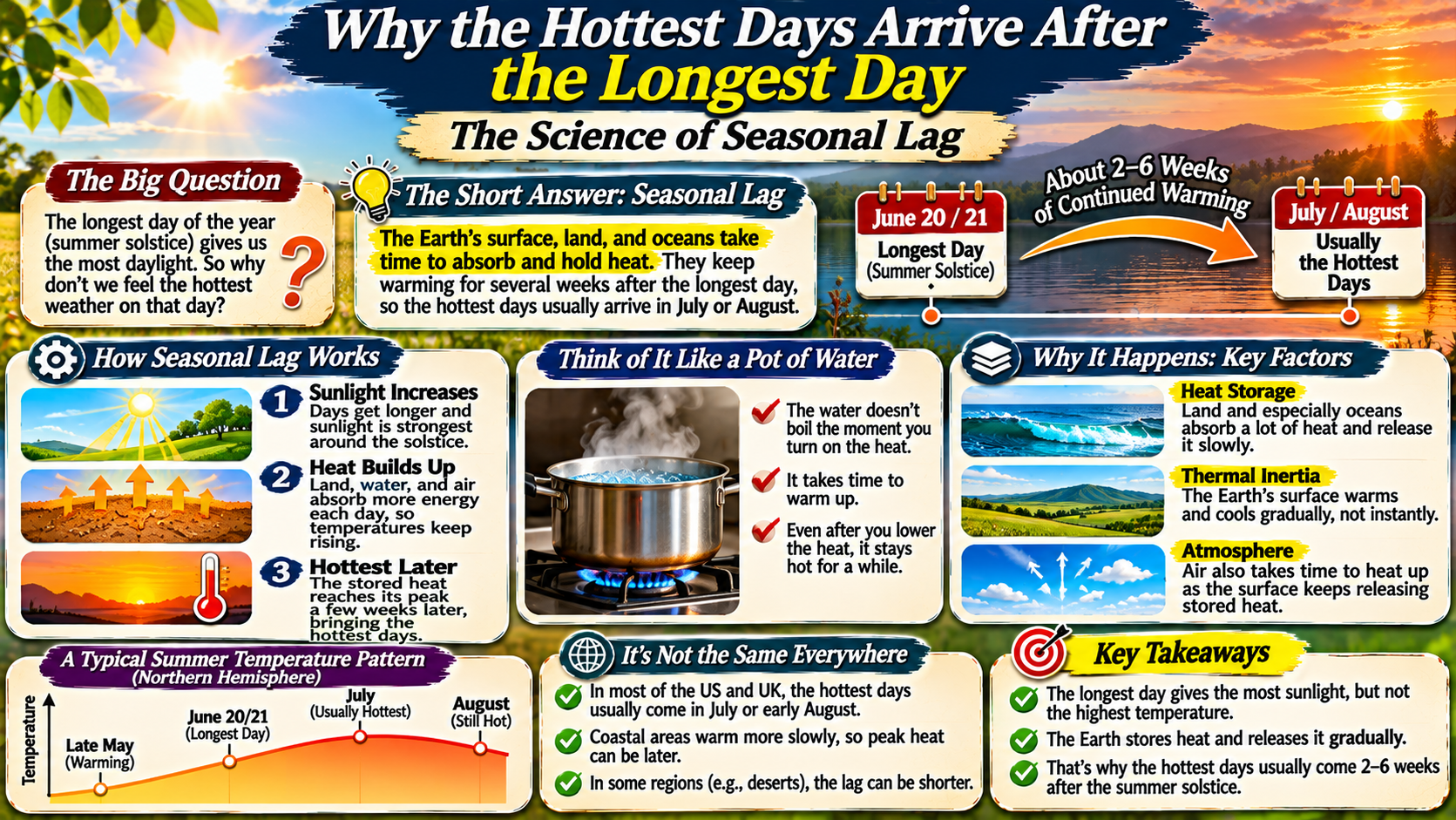
This delay is called seasonal lag.
The explanation lies in the difference between receiving solar energy and accumulating heat. Earth’s surface does not immediately reach its highest temperature when sunlight is strongest.
Instead, land, water, and air continue warming while the energy they absorb exceeds the energy they lose.
What Is Seasonal Lag?
Seasonal lag is the delay between the time of maximum or minimum seasonal sunlight and the corresponding peak or minimum in average temperature.
In much of the Northern Hemisphere, the longest day occurs in June, but the warmest period follows in July or August.
A similar delay happens in winter. The shortest day arrives in December, while many locations experience their coldest average weather in January or February.
The timing varies considerably by region.
Some inland locations warm and cool relatively quickly. Coastal regions may respond more slowly because nearby oceans store substantial amounts of heat.
Seasonal lag is a feature of average climate patterns, not a rule predicting the hottest individual day in every year.
Why the Summer Solstice Is Not Usually the Hottest Day
The summer solstice represents a peak in the seasonal supply of sunlight at many Northern Hemisphere locations.
However, temperature depends on the balance between energy entering and leaving the local climate system.
Even after the solstice, the days remain relatively long and the Sun stays high in the sky.
For several more weeks, absorbed energy can continue to exceed energy losses.
That positive energy balance allows the surface and lower atmosphere to keep warming.
Eventually, the seasonal energy balance shifts.
As daylight decreases and the Sun’s path becomes lower, incoming energy declines enough for cooling to begin dominating the seasonal trend.
The warmest average temperatures generally occur around this transition, although atmospheric circulation and local conditions can alter the timing.
CORE CLIMATE PRINCIPLE
Maximum Sunlight Does Not Mean Maximum Stored Heat.
Temperatures can keep rising after solar input begins decreasing because the land, oceans, and atmosphere are still accumulating energy.
A Simple Seasonal Timeline
This timeline describes a common midlatitude Northern Hemisphere pattern. Actual seasonal peaks vary with geography and climate.
The Role of Earth’s Heat Storage
Earth’s surface stores energy received from the Sun.
Soil, rock, vegetation, buildings, lakes, and oceans all absorb energy during daylight.
They also release energy through radiation, evaporation, and heat exchange with the atmosphere.
However, these processes take time.
A surface that has been warming for several weeks can remain warm even after the daily amount of incoming sunlight begins declining.
Scientists describe the resistance of a system to temperature change as thermal inertia.
Materials with greater thermal inertia generally warm and cool more slowly.
This concept helps explain why the seasonal temperature cycle does not exactly match the annual cycle of solar radiation.
Why Oceans Create a Longer Temperature Delay
Water has a relatively high specific heat capacity, meaning it requires substantial energy to raise its temperature.
Oceans also distribute absorbed heat through mixing and currents.
Sunlight can penetrate beneath the surface, allowing energy to be stored through a layer of water rather than only at the top.
These properties make ocean temperatures respond more slowly to seasonal changes than many land surfaces.
Coastal climates are strongly influenced by this stored ocean heat.
During spring and early summer, cool seawater can moderate nearby air temperatures.
Later in summer and into autumn, warmer seawater may help keep coastal regions mild even as daylight decreases.
Ocean influence is one reason some maritime locations experience later temperature peaks than continental interiors.
LAND SURFACES
Faster Response
Land often heats and cools relatively quickly, producing larger seasonal temperature changes in many inland regions.
OCEAN SURFACES
Slower Response
Water stores and redistributes substantial heat, often delaying the warmest and coolest seasonal conditions.
Why the Hottest Part of the Day Also Comes Later
Seasonal lag has a familiar daily equivalent.
Solar noon is the time when the Sun reaches its highest position in the sky.
However, the highest afternoon temperature usually occurs later.
After solar noon, the ground may continue absorbing more energy than it loses.
As a result, surface and air temperatures can keep increasing for several hours.
The daily temperature peak occurs when the local balance of heating and cooling changes.
Cloud cover, wind, humidity, and weather fronts can shift this timing.
The seasonal cycle works on a much longer timescale, but the underlying energy-balance principle is similar.
Why Seasonal Lag Differs Between Regions
Not every location reaches its highest average temperature at the same time.
Geography plays an important role.
Inland areas often experience larger seasonal temperature swings because they are less influenced by ocean heat storage.
Coastal areas may experience delayed warming and cooling.
Elevation also matters because higher locations generally have different temperature conditions and atmospheric characteristics.
Prevailing winds can transport warm or cool air from distant regions.
Cloud patterns, rainfall, soil moisture, and snow cover influence how much solar energy reaches and warms the surface.
In monsoon regions, increased cloudiness and rainfall can interrupt the warming trend before the summer solstice.
This means the hottest part of the year may occur before the longest day in some climates.
Seasonal Lag in the United States and United Kingdom
Many parts of the United States experience their highest average temperatures in July or August.
However, the timing varies across the country.
Some inland regions reach peak warmth earlier than locations influenced by cooler coastal waters.
Along parts of the Pacific coast, marine conditions can delay the warmest period.
In the United Kingdom, July and August are generally the warmest months, although the precise ranking varies by location and year.
The surrounding Atlantic Ocean and nearby seas strongly influence British temperatures.
These examples demonstrate why the warmest month is a regional climate characteristic rather than a date fixed by the solstice.
Does the Same Thing Happen in the Southern Hemisphere?
Yes. Seasonal lag also occurs in many Southern Hemisphere locations.
There, the summer solstice takes place around December 21 or 22.
Many regions experience their warmest average temperatures during January or February.
However, the Southern Hemisphere contains a much larger proportion of ocean surface than the Northern Hemisphere.
This influences seasonal heat storage and the timing of temperature changes.
Local climate patterns still matter, so the delay differs among Australia, South America, southern Africa, and oceanic islands.
The general principle remains the same: temperature responds to accumulated energy rather than instantaneously matching the amount of sunlight.
Is Seasonal Lag Caused by Earth’s Distance from the Sun?
No. Earth’s distance from the Sun is not the main reason for the seasons or their temperature lag.
The primary cause of the seasons is Earth’s axial tilt of approximately 23.4 degrees.
This tilt changes the angle and duration of sunlight received at different latitudes throughout the year.
Earth is actually closest to the Sun in early January and farthest away in early July.
Despite this, January is winter in much of the Northern Hemisphere.
The timing demonstrates that distance from the Sun does not explain the familiar seasonal pattern.
Seasonal lag results mainly from the delayed temperature response of Earth’s climate system to changing solar energy.
Does Climate Change Affect Seasonal Lag?
Climate change alters temperature patterns, ocean heat content, snow cover, and atmospheric circulation.
These changes can influence the timing and intensity of seasonal warmth.
However, the effect is not uniform across all regions.
A warmer climate does not automatically mean that the hottest average day will occur earlier or later everywhere.
Researchers examine long-term temperature records to understand how seasonal cycles change over time.
It is important to distinguish a long-term climate trend from a single unusually hot summer or heatwave.
Common Misunderstandings About the Longest Day
CLIMATE NOTES / MYTHS & FACTS
Myth: The longest day must be the hottest day.
Fact: Average temperatures often peak later because heat accumulates over time.
Myth: Shorter days immediately cause cooling.
Fact: Temperatures can continue rising while incoming energy remains greater than outgoing energy.
Myth: Every location has the same seasonal lag.
Fact: Oceans, geography, winds, and rainfall create regional differences.
Myth: Earth’s distance from the Sun determines summer.
Fact: Axial tilt is the primary cause of the seasons.
Myth: The hottest day always occurs in August.
Fact: Individual weather extremes and local climate patterns can produce the hottest day at many different times.
Frequently Asked Questions
Why is July often hotter than June?
Even after the June solstice, land and water can continue accumulating heat, allowing average temperatures to rise for several more weeks.
What does seasonal lag mean?
Seasonal lag is the delay between peak seasonal sunlight and the corresponding warmest or coldest average temperatures.
How long does seasonal lag last?
It varies by location. Many midlatitude regions experience a delay of several weeks, while some ocean-influenced climates show longer delays.
Why are coastal areas often warm later in summer?
Nearby oceans absorb, store, and release heat slowly, moderating and sometimes delaying seasonal temperature changes.
Why is the coldest weather often after December?
After the winter solstice, the surface may continue losing more energy than it gains, allowing average temperatures to fall further.
Does seasonal lag occur everywhere?
Many regions show seasonal lag, but its size and even its direction vary. Monsoon climates and some tropical regions can follow different temperature patterns.
Final Thoughts
The longest day of the year marks a turning point in the annual cycle of sunlight, but it does not usually mark the peak of summer heat.
Land, oceans, and the atmosphere continue absorbing and storing energy after the solstice.
As long as the seasonal energy balance favors warming, temperatures can keep rising despite gradually shortening days.
The delay between peak sunlight and peak average temperature is known as seasonal lag.
Its timing depends on heat storage, geography, ocean influence, and regional weather patterns.
Understanding seasonal lag explains why July and August are often warmer than June—and why the coldest winter weather frequently arrives after the shortest day.
It also reveals a broader principle of climate science: Earth’s temperature responds to energy accumulated over time, not simply to the sunlight received at a single moment.